
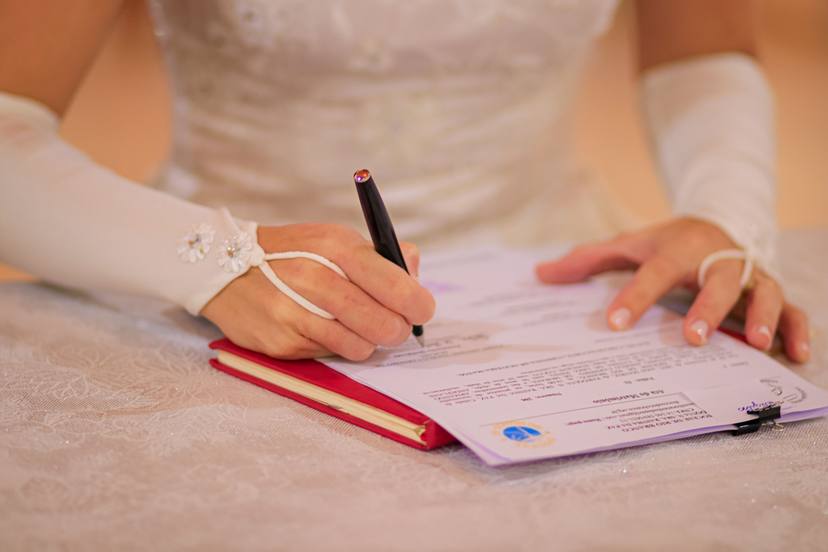
The confetti has settled and the tan is fading — now comes the quietly bureaucratic business of becoming a Mrs, a Mr, or a double-barrelled new household.
You have married in the sunshine, the photographs are beautiful, and somewhere in your hand luggage is a marriage certificate that is about to become the most important piece of paper you own. What nobody quite tells you is that the name change itself happens not on the day, but in the weeks afterwards, in a fairly ordinary sequence of forms. It is entirely manageable — you simply need to know the order to do things in.
Start with your marriage certificate, properly
Whichever destination you marry in — Cyprus, Greece, Malta, Spain or Italy — you will be issued an official marriage certificate, and in most cases a version with an apostille or equivalent international certification confirming it is a legitimate public document. Check before you leave that you have the correctly certified version, not just a commemorative certificate for framing. Keep the original somewhere safe and take two or three certified copies home with you, since several UK organisations will want sight of the document and some will not return it quickly.
If your certificate is not in English, you may also need a certified translation before UK institutions will accept it. This is one of the small details our team talks couples through before they travel, precisely because it is so easily overlooked in the excitement of planning the wedding itself.
Thinking about a wedding abroad? Talk to a planner: a free, no-obligation chat, and we reply within one working day.
Start your enquiryRegister the marriage in the UK records, if applicable
Marrying abroad does not automatically create an entry in UK marriage records — your foreign marriage certificate is what proves you are married, and for most purposes that is sufficient. You do not need to "re-register" the marriage in the UK in the way some couples assume. What you do need is for that certificate to be accepted by the organisations that matter: your bank, your passport office, your employer, HMRC, and so on. Each will have its own small print about what they will accept, which is why doing a short telephone check with your bank or the passport office before you fly home can save a repeat conversation later.
Your passport comes first
Once home, your passport is usually the sensible starting point, because so many other organisations will ask to see a passport in your new name before they update their own records. HM Passport Office will ask for your original marriage certificate, your current passport, and a completed application form, along with a new passport photograph. Processing takes several weeks, so if you have a holiday booked soon after the wedding, it is worth checking whether you can comfortably travel on your old passport in the meantime, since the name on your passport and the name on your other travel documents will need to match.
If only one of you is changing name, you can both continue travelling under your existing passports in the meantime — there is no requirement to update everything at once, and plenty of couples take their time with the wider paperwork while keeping travel documents as they are until a trip is on the horizon.
The everyday admin: banks, doctors and driving licences
With a new passport in hand, the rest tends to follow in a predictable order. Your bank will usually want to see the passport and marriage certificate together, and most allow this to be done in branch or, increasingly, online with scanned documents. The DVLA will update your driving licence for a small fee, and you will need a new passport-style photograph for that too. Your GP surgery, dentist and any pension or workplace records are easy to overlook but worth doing early, particularly if you are changing your name across insurance policies, where a mismatch between your name and your policy documents can cause real delay if you ever need to make a claim.
If you are employed, HR and payroll will need updating so that your salary, pension contributions and tax records all align — HMRC in particular can flag a mismatch between your employer's records and your National Insurance details, which is a nuisance to unpick later rather than a disaster, but better avoided.
A gentle note on timing and double-barrelled names
If you are combining surnames, hyphenating, or one of you is taking the other's name while keeping a professional name for work, it is worth deciding this before the wedding rather than after, simply because your marriage certificate will usually need to reflect the legal version of your new name for everything downstream to line up neatly. We always encourage couples to talk this through with us during planning, so that the certificate issued on the day already matches the paperwork trail you intend to create afterwards.
None of this needs to happen in a single frantic week. Most couples find it sensible to tackle the passport first, the bank and driving licence within the first month or two, and the smaller accounts — subscriptions, store cards, the dentist — whenever it is convenient.
We think the paperwork should feel like the smallest part of your wedding abroad, not the part that lingers longest. Alongside full planning, guest accommodation and on-the-ground concierge support in Cyprus and across our other destinations, we talk every couple through exactly what their marriage certificate will look like and what to do with it once you are home. If you would like to talk through your plans, we would be glad to arrange a free consultation and answer whatever questions are on your mind, paperwork included.